

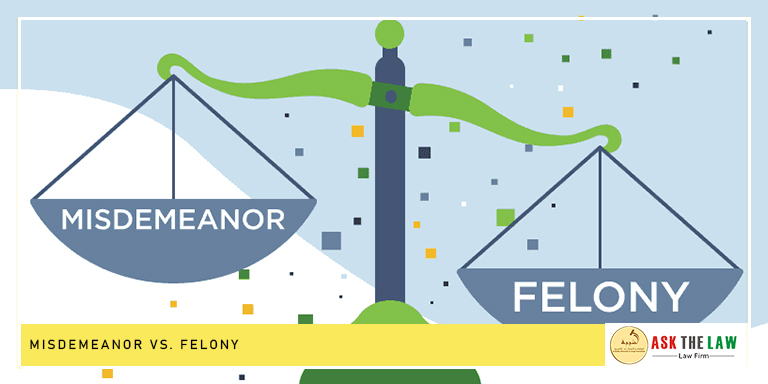
Misdemeanor vs Felony
The misdemeanor vs felony is explained by common law to define the legal structure and legislation in the United Arab Emirates. For a clear understanding from the start, we can say that misdemeanors are less severe offenses, and felonies are considered serious offenses. It means across most legal systems, misdemeanors mean limited harm or small-level violations, and on the other hand, felonies are serious threats to safety, property, assets, or even to national interests.
The felonies may cause penalties and fines to increase according to the seriousness of the offence/crime. The penalties of a felony can be very serious in nature having heavy fines, deportations and imprisonment.
Court procedures in felony cases become more complex with higher offence levels. The definition of these lawyers can be clearly understood with the support of professional lawyers. Misdemeanor subjects are not very complicated in court. However, it is the situation, nature and intention which makes an offense or crime misdemeanor or felony.
What is a Criminal Offence Under UAE Law
Common Law in the UAE is explained under its federal criminal classification structure into three categories:
- Contraventions: Minor offences
- Misdemeanours: Misdemeanors mean mid-level offenses
- Felonies: Serious Offenses
This classification structure helps to determine the type of punishment, court jurisdiction, and investigation process, course of action, federal laws, punishments, and long-term legal consequences. It creates an ease to define the crime and figure it out the suitable course of action and punishment. UAE Federal Decree Law No. 31 of 2021 governs the classification of offences. The federal law defines the criminal responsibility, range of punishments and investigation procedures. The federal law also defines the seriousness of the crime which makes the crime either a minor offense or serious.
What Is a Misdemeanor and the Punishments?
A misdemeanor means that if the offence is not very serious but it requires a legal follow-up to avoid the situation, which can be complicated or very serious in future. Simple assault without permanent injury, any verbal insult, or defamation, are all misdemeanor crimes under UAE federal laws. Professional criminal law lawyers are very helpful for the right understanding of UAE Law.
Financial crimes with a moderate offence, like cheque bounce without fraudulent intent, minor financial disputes, or limited property damage, are all classified as misdemeanors. Although harassment is a very serious crime, but the crime depends on the intentions.
The cases under the Misdemeanor are dealt with moderate offences, and charges are not very serious. Under federal laws, the misdemeanor may face charges such as imprisonment from 1 month up to 3 years, fines starting from AED 1,000 and increasing depending on offence severity, and deportation orders in some expatriate cases. Under the federal legal system, the Public Prosecution prosecutes misdemeanour offences through its legal procedures. Once a complaint is filed, prosecutors determine whether the case should proceed or not.
Misdemeanour offences involve moderate punishments result in imprisonment or medium/small level fines. Courts can also impose travel restrictions. Additional consequences can be employment restrictions, or licensing limitations.
What Is a Felony and Punishments?
Felonies are serious criminal offences and involve strong penalties designed to protect public safety. Serious financial scams, like large-scale financial fraud and corruption offences, are considered felonies. There is a list of crimes considered under Felony which can be checked with experienced lawyers and legal consultants.
UAE government doesn’t have any soft corner for smugglers and drug trafficking, these also called felonies and high degree charges that can be followed. Serious charges are imposed for felony like imprisonment between 3 and 15 years, life imprisonment, and deportation orders for expatriates.
Additional legal consequences can be permanent criminal records, confiscation of assets, deportation for expatriates, and permanent licensing restrictions.
Latest Legal Reforms
Criminal Laws are modified in the UAE, and significantly reshaped how to categorize as Misdemeanor or Felony.
1. Cheque Bounce Reform
One of the most important categories of revision concerns cheque-related offences. Previously, cheque bounce cases were automatically treated as criminal offences. Now, cheque-bounce matters are mostly administrative unless any fraudulent intent is found. Issuing a cheque deliberately without funds still qualifies as a criminal offence, and it will not be treated under misdemeanor.
2. Alternative Sentencing
Modern criminal policy now allows courts to impose alternative penalties instead of imprisonment. For moderate punishments under revised UAE federal laws, imprisonment is replaced with community service penalties. Electronic monitoring helps to ensure the punishment fulfillment. Details and rules are changed with the passage of time. Therefore, it is suggested to consult the professional lawyers and legal consultants. Professional lawyers and legal consultants can guide better about the latest information and rules.
3. Cybercrimes in the UAE
UAE Cybercrime laws are introduced to regulate social media and digital safety in the UAE. Digital-era offences increasingly fall within felony-level crimes. All the cybercriminals conduct identity theft, data-breach exploitation, and electronic impersonation are referred to as felons. Online Fraud is also a very serious charge, and if somebody is involved in online fraud schemes and cyber, extortion will face serious consequences. Cybercrimes are treated very seriously in UAE. UAE has special legal provisions and federal laws on Cybercrimes.
Importance of Classification
Courts evaluate intent carefully when determining whether an offence qualifies as a misdemeanor or felony. According to the UAE federal laws, judges consider Misdemeanor or Felony after very careful analysis. It means judges make no mistakes while differentiating between felony and misdemeanor.
Court Process: Misdemeanor Cases
Misdemeanor cases are simple to deal with and follow the simplest structure. To register Misdemeanor cases, a police complaint is important, and then the Public Prosecution will review the case, and the Criminal Court will hear the final Judgment
If Misdemeanor cases are insult cases or minor financial disputes, a settlement may be possible. For minor Workplace-related criminal Misdemeanor cases can be dealt with minor charges.
Court Process: Felony Cases
Felony cases involve a longer procedure than other types. Police investigation and prosecution interrogation are very much important in felony Cases. If the felony cases seem complicated and have serious charges, it also includes a forensic review of detention decisions during felony court trials to complete appeal procedures. It can also involve other medical reports and investigations.
• Travel Restrictions in Criminal Cases
Travel bans commonly arise during felony investigations and execution proceedings. Recent procedural reforms allow travel bans to be lifted once settlement or judgment execution occurs.
Role of Public Prosecution in Criminal Classification
Public Prosecution authorities play an important role in determining if evidence supports criminal charges or an offence qualifies as a misdemeanor or felony. Public Prosecution also decides if detention is required and facilitates settlement procedures that are available.

Note:
ASK THE LAW is the Online Legal Entity of Al Shaiba Advocates & Legal Consultants, a full-service Emirati Law Firm. The blog is just for legal knowledge, which can be outdated with time with the inventions of new laws or modifications in previous laws. There might be some human errors too in the blog content. Therefore no liability is taken or owned, and we suggest consulting our experts for any decision or proceedings.