

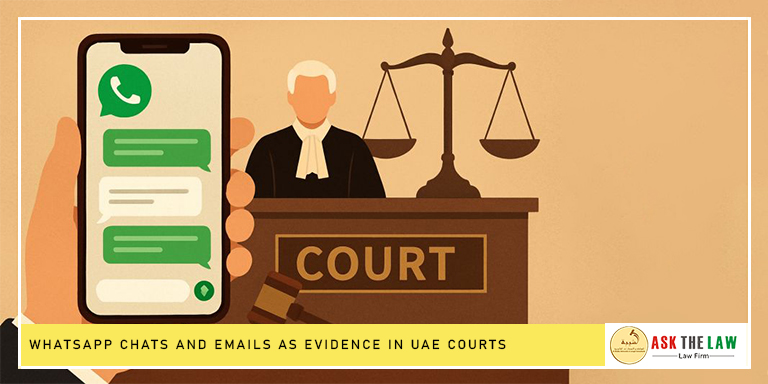
WhatsApp Chats and Emails as Evidence in UAE Courts
The digital communication system is dominating the modern world. The modern world is not complete without the support and presence of digital communication systems. Because this is a mandatory requirement to manage the modern world. In the UAE, social messaging applications like WhatsApp and business communication apps, email apps, have become an important mode of dealing and communicating in personal and professional life. WhatsApp and different email apps are widely used in the UAE. The wide use of WhatsApp messages and email in personal life and businesses has also taken the path as evidence in the courts.
Can WhatsApp chats and email correspondence be used as evidence in the UAE courts or not, let us throw the light on it.
Electronic messages can be presented as evidence in the UAE court cases, and the court accepts the e-messages e.g, WhatsApp messages or email correspondence. They are accepted under certain legal requirements. The criteria of such evidence should be met, or they can also be rejected under some circumstances. It has to be submitted to court in Arabic translation.
What are the different types of E-Evidences
The digital communication evidence or E-Evidences those are acceptable in the UAE courts are as follows:
- WhatsApp Messages
- Emails
- Screenshots
- Chat Records
- Lawful Audio and Video recordings (but under strict legal conditions) (Permission is needed)
- Online Transactions (Real, based on facts)
- Digital Files and Documents (If legal conditions are met)
These digital media contents are new types of evidence in this era. This evolution has changed the perspective on how disputes were resolved in the past. It has also changed the process the accusations were used to be investigated for reaching to a conclusion.
Electronic Evidence Recognized Under UAE Federal Laws
The UAE courts now recognize the electronic evidence but under some legal consideration and circumstance. Digital communication should demonstrate some key facts related to the case and those must be relevant. For example, if the messages are based on the facts related to direct disputes, threats, then these can become the strong and acceptable evidence in the court. Online transactions, bank transactions, E-receipts, invoices, purchase orders can also be taken as evidence, by court.
Admission to something in a message or with a prof can also be considered. The main thing is that it should be reliable, authentic, and related to the matter of the court. UAE courts routinely rely on WhatsApp conversations and emails in all types of cases, especially in civil and criminal cases. Electronic evidence has become especially important in commercial cases where communication happens informally over chat applications instead of formal written contracts.
The rapidly growing acceptance of this modern digital evidence shows the UAE’s broader legal transformation, progress and development, as well as an approach towards modernization. It is very well understood, that modern problems need modern solutions. Modern issues cannot be resolved with old mediums or technologies. The acceptance of digital factors as evidence and technological integration in cases has faster dispute resolution. It gives better results and increases the time. Digital factors or digital mediums can perform better and help to resolve the disputes immediately. It helps to catch the convicts quickly and to reach a court verdict efficiently. Professional and trusted lawyers have always-strong impact on litigation and its process. The businesses and individuals should understand the importance of such evidence and know how these can be evaluated in court.
Authentication of Digital Evidence in UAE
The WhatsApp chats and emails can be used as evidence. The main thing is that these should meet the strict criteria. These should be authentic and verified. It has to be translated in Arabic while submitting to experts or court during the court process.
The court only process the evidence as real where the sender and the receiver are correctly identified. There should be no alteration in the chats, and the context of the topic should not be manipulated.
The parties who rely on electronic media should submit the full chat history as evidence, with all the voice notes and attachments. Timestamps, screenshots, and metadata can also be taken as the part of evidence but there should supporting documents to make them trustworthy.
The messages are certified by the forensic experts and IT departments UAE. These are all authorized experts and related to government entities. The court looks at the matters and take it as useful if the chats are complete and not cropped, and the sender is properly identified by the name and full profile. Partial or selectively edited screenshots are subject to rejection if they lack context. Manipulated chats are also rejected.
WhatsApp Chats as Evidence in Criminal Cases
WhatsApp messages have become a vital form of evidence in criminal cases held in the UAE courts. The law enforcement agencies and prosecutors strongly rely on these modes of communication because these are common and used by the vast public.
The chat histories are taken as proof to show the truth and support investigations. These electronic messages can provide proof in a wide range of criminal matters. If it includes threats and intimidation, these cases turn the cases. Fraud, drug-related activities, and other types of criminal offenses are also dealt in the country using e-messages as proof.
Harassment, defamation, and human trafficking cases also strongly rely on the electronic media as proof.
Digital messages if contain direct admissions, images, and transactional requests, this make them a valuable as factual evidence. The UAE’s cybercrime laws empower authorities to extract, verify, and evaluate this digital evidence to use in court.
In more serious cases, the police with the authority obtain evidence directly from electronic devices. If it is not possible, they can submit official requests to service providers for access to relevant data. This procedure is carried out within the legal boundaries.
Emails as Evidence in Civil and Commercial Litigation
Emails are also considered highly reliable format of evidence in the UAE and across the world. It is particularly considered in business-related disputes. Apart from business disputes, Emails are very authentic evidence for employment, real estate or even family related problems. Emails are proved good evidence for business negotiations, agreements, delivery services, service promises, product delivery, or to meet deadlines. One of the main advantages of emails is that they are traceable and time-stamped. Emails are very easier to authenticate as compared to other informal chats. The UAE legal system places importance on emails. These are considered as key evidence in UAE courts.
Why Screenshots alone do not work or do not work a lot?
Screenshots are also submitted as evidence in UAE courts. Just screenshots alone are not acceptable in courts, unless it is generating some meaningful subject. This is because they might lack credibility. The legal value of a screenshot as evidence increases when it is supported by additional context, Emails or attachments. As we said it is not useful unless it generates some meaningful content or subject.
The presenter of the evidence has to make sure the screenshots are fact related and not tampered, it will not be considered evidence in court, otherwise. If the authenticity of a screenshot is disputed and not clear. Such decisions do depend solely on the court. Court can accept and can reject as well.
Formal Submission of Digital via Legal Channels
There are some rules set must be considering while submitting digital evidence. This evidence must be attached to the case file, expert reports, or witness statement. The court jurisdiction guidelines include to submit the evidence via official digital platforms,
The legal experts recommend the collection of additional files to strengthen the credibility and reliability of digital evidence. This additional data is in the form of original files, full chat exports, complete PDFs of email threads, call logs, and any supporting documents that corroborate the evidence.
Courts Evaluation
When UAE courts review WhatsApp chats and emails, they just don’t look at the words on the screen. They go through the work comprehensively to understand the intention and the context behind it. You can take an example of a harassment case. In such cases, the court examines how frequently the messages were sent, the tone and the intention, of sender. These factors are carefully examined to find out that whether the communication leads to harassment or not. Similarly, court also evaluates carefully for the false complaints.
UAE Federal Laws and its Support
The UAE’s federal and emirate laws are advancing to keep pace with IT, and cybersecurity needs. Several federal laws now provide a strong foundation for accepting digital evidence in all the legal matters including civil, commercial and criminal cases. The Federal Laws those are recognized as follows:
- Federal Decree-Law No. 34 of 2021 on Cybercrime
- Federal Evidence Law
- Civil Procedure Law
- Electronic Transactions Law
These laws allow courts to rely on digital records. People involved in forgery, identity fraud and defamation will have to face harsh punishments. We strongly suggest always consult the legal experts.
Final Thoughts
WhatsApp messages, emails, and other digital communications channels have positive sides but they can also be taken as powerful evidence in the UAE and the rest of the world.
These evidence and proofs can only be accepted if they are accurate, reliable, and relevant to the case and properly presented through legal channels. Further, you can grab good idea if you consult specialist attorneys and legal consultants. You can find several quality lawyers in Emirate of Dubai.

Note:
ASK THE LAW is the Online Legal Entity of Al Shaiba Advocates & Legal Consultants, a full-service Emirati Law Firm. The blog is just for legal knowledge, which can be outdated with time with the inventions of new laws or modifications in previous laws. There might be some human errors too in the blog content. Therefore no liability is taken or owned, and we suggest consulting our experts for any decision or proceedings.